|
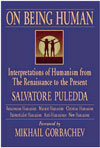
On Being Human: Interpretations
of Humanism from the Renaissance to the Present by Salvatore
Puledda, foreword by Mikhail Gorbachev
"We live in a period of
transition... the book by Salvatore Puledda...is therefore
most timely...makes fascinating reading and I recommend it
warmly." -- Ilya Prigogine, Nobel Laureate
"[a] stimulating inquiry...concise,
lucid survey...a springboard for thought and action."
--Publishers Weekly
Who are we, these fascinating
and restless creatures called human beings? Is there a fixed
"human nature" predetermining our actions, or does
human existence encompass the liberty to make moral choices,
to change the direction of our lives and society as a whole?
These questions are more than abstract philosophical issues:
as events in our world accelerate, each of us must make choices
affecting both our own lives and those around us. And agreement
about human nature and freedom is far from unanimous every
major political and religious movement has answered these
questions in their own, often divergent ways.
In this illuminating work, from
which readers can draw insights for their own lives, the author
poses the central question of what it is to be fully human.
Beginning with the Renaissance, he surveys primary sources
for such seemingly contradictory approaches as Marxist Humanism
(Marx, Engels, etc.), Christian Humanism (Maritain), and Existentialist
Humanism (Sartre), as well as critical voices (Heidegger,
Lévi-Strauss, Foucault), concluding with New Humanism
and Silo's thought, which shows the need for a new and universal
humanism that must be, more than an idea or a philosophy,
a human attitude, capable of bringing people together while
respecting their diversity.
Translated by Andrew Hurley.
|